

Africa imports a significant amount of what its consumers use every day.
Furniture. Equipment. Building materials. Household products. Manufactured goods.
But what happens when more of those products are made on the continent, for the continent?
The answer goes beyond reducing imports.
Local manufacturing can create jobs, build technical skills, strengthen supply chains, support smaller businesses and keep more economic value within African markets.
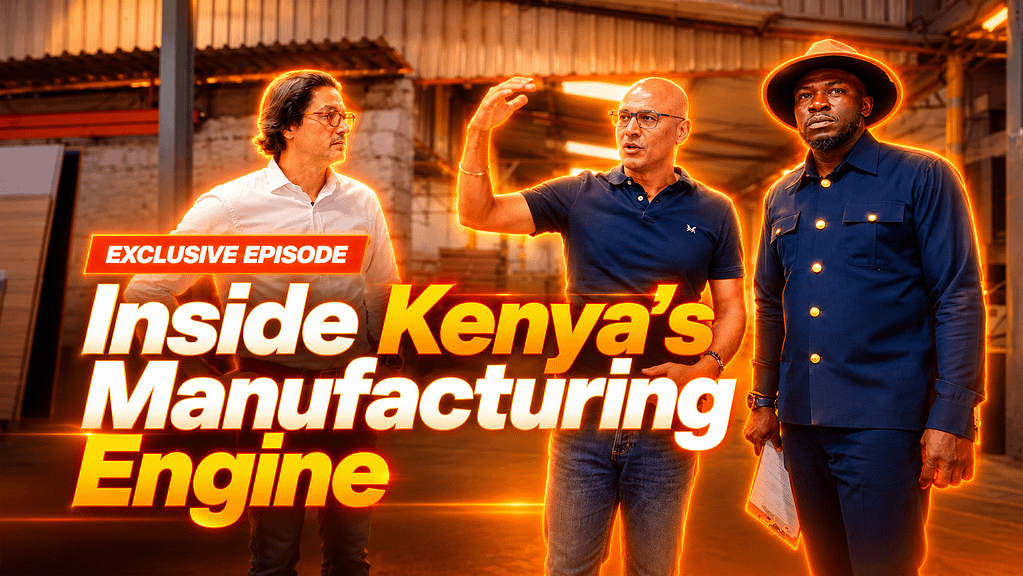
In this episode of the Building for Africa Investment Show, we visit PG Bison Kenya to explore what more than two decades of operating and investing in an African manufacturing market can teach investors, businesses and policymakers.
PG Bison’s operation in Kenya is built around furniture components and interior solutions for homes, offices, hotels and commercial spaces. The Kenya business operates through a partnership with the South African business, combining raw-material production with local value addition and manufacturing. Pasted text(3)
But the bigger story is not furniture.
It is about what becomes possible when investors take a long-term approach to African manufacturing.
Africa’s Manufacturing Opportunity Is Bigger Than One Country
PG Bison has operated in Kenya for more than two decades.
That longevity matters.
African markets are often discussed through short-term indicators: currency movements, elections, policy changes or the economic outlook for a particular year.
But manufacturing investment works differently.
Factories, machinery, distribution networks, skills development and supply chains are not built for the next quarter.
They are built for years.
During the conversation, the PG Bison team acknowledges that doing business comes with challenges, including changing taxes, currency pressures, logistics costs, energy costs and infrastructure constraints. But they also make an important point: challenges exist in markets around the world; what matters is understanding the environment and learning how to operate within it. Pasted text(3)
That is an important distinction for investors looking at Africa.
The question should not simply be:
“Does this market have challenges?”
Every market does.
The better question is:
“Does the long-term opportunity justify learning how to navigate those challenges?”
For many sectors across Africa, the answer may increasingly be yes.
Local Partnerships Can Make or Break Market Entry
One of the strongest investment lessons from the episode is the importance of local market intelligence.
Entering an African market with capital and technical expertise is not always enough.
Businesses also need to understand:
- consumer behaviour,
- distribution,
- pricing,
- regulation,
- business culture,
- customer expectations,
- local talent,
- and how relationships work within the market.
The PG Bison team strongly recommends finding the right local partners when entering a new market.
Their own operation represents a long-running partnership that combines outside expertise with deep local knowledge. They argue that businesses entering without sufficient understanding of the market can learn expensive lessons, while the right partnership can help combine international capability with local insight. Pasted text(3)
This principle applies far beyond manufacturing.
For investors entering Nigeria, Kenya, Ghana, Rwanda, Côte d’Ivoire, South Africa or any other African economy, local knowledge is an asset.
It can help companies move faster while avoiding mistakes that might have taken years to understand independently.
Import Substitution Is an Investment Opportunity
One of the most interesting themes in this conversation is import substitution.
Africa imports billions of dollars’ worth of finished products that, in many cases, could increasingly be manufactured or assembled locally.
PG Bison sees imported furniture as part of the market opportunity.
Rather than simply competing with other domestic manufacturers, the business is also asking:
How much of what is currently imported could be produced locally instead?
That changes the size of the opportunity.
The team explains that increasing local production allows more value to remain within the domestic economy rather than importing the finished product. Pasted text(3)
The multiplier effect can be significant.
Local manufacturing can create demand for:
- logistics companies,
- installers,
- retailers,
- contractors,
- designers,
- maintenance providers,
- raw-material suppliers,
- technology providers,
- professional services,
- and skilled workers.
One factory can therefore support a much larger ecosystem.
This is why manufacturing policy should not only be viewed through the factory gate.
The economic value spreads across the value chain.
Manufacturing Investment Creates Jobs Beyond the Factory
PG Bison reports employing approximately 250 people across its operations, while also working with a network of roughly 200 downstream businesses or partners involved in fabrication, assembly and delivery.
The episode estimates that these businesses can support around another thousand jobs across the wider value chain. Pasted text(3)
This is an important part of the investment case for manufacturing in Africa.
A manufacturing company does not simply employ machine operators.
Its activity can create work for people across transportation, construction, installation, sales, design and other services.
This is the difference between looking at investment only through a company’s balance sheet and looking at its broader economic footprint.
For African policymakers seeking employment growth, that multiplier effect is significant.
For impact-oriented investors, it makes manufacturing particularly interesting.
Capital can potentially produce both:
financial returns and measurable economic participation.
Africa Must Invest in Skills Alongside Machinery
Modern manufacturing requires more than buying equipment.
It requires people capable of operating, maintaining and improving that equipment.
The PG Bison conversation highlights an important skills challenge: specialised machinery sometimes requires expertise that is not readily available through existing vocational institutions.
The company responds by bringing in technical expertise, providing training, working with interns and collaborating with organisations that support workforce development. Pasted text(3)
This reveals a much broader issue.
If Africa wants to industrialise, the continent cannot separate manufacturing policy from skills policy.
Factories need:
- technicians,
- machine operators,
- engineers,
- software specialists,
- maintenance professionals,
- production managers,
- designers,
- logistics professionals,
- and quality-control specialists.
Investment in machinery without investment in people creates a bottleneck.
The countries that successfully connect technical education with the needs of industry will be better positioned to attract and retain manufacturing investment.
Women Must Be Part of Africa’s Industrial Growth
The episode also explores gender participation on the factory floor.
PG Bison says women now represent roughly a quarter of the employees working in that part of its manufacturing operation, up from effectively zero two years earlier.
The company describes this as the result of a deliberate effort to improve gender balance. Pasted text(3)
That matters.
Africa cannot build its manufacturing future while excluding half of its potential workforce.
Greater participation by women in manufacturing, engineering, technology and skilled trades expands the talent pool while creating new economic opportunities.
And as this example suggests, representation does not always improve accidentally.
Sometimes it requires intention.
Sustainability and Manufacturing Can Grow Together
Industrial growth and environmental responsibility are sometimes presented as competing priorities.
They do not have to be.
PG Bison says the wood fibre used in its products comes from certified sustainable forestry sources and that the business maintains a chain of custody that allows it to trace the origin of its material. Pasted text(3)
The factory has also been working to reduce waste.
During the tour, the team describes:
- replacing much of its plastic packaging with cardboard and paper,
- collecting production dust,
- repurposing wood waste,
- recycling aluminium,
- recycling steel,
- recycling paper,
- and directing materials back into productive uses rather than simply disposing of them. Pasted text(3)
This is the circular economy in practice.
For African manufacturing, this creates another investment opportunity.
The question is not just:
What can Africa manufacture?
It is also:
How can Africa build modern manufacturing systems that are more efficient, sustainable and resource-conscious from the beginning?
Renewable Energy Can Strengthen African Industry
Energy is one of the largest operating considerations for manufacturers.
And it is also an area where Africa has significant potential.
PG Bison says solar power now covers a substantial proportion of its energy needs, with the plant running at approximately 90% solar during daily usage periods and solar accounting for around 60% of monthly requirements, according to the interview. Pasted text(3)
This highlights the growing relationship between renewable energy and African industrialisation.
Solar and other distributed energy systems can help manufacturers:
- manage energy costs,
- reduce dependence on the grid,
- improve reliability,
- reduce carbon intensity,
- and make production more sustainable.
For investors, this means Africa’s industrial opportunity is interconnected.
Investment in manufacturing creates demand for energy.
Investment in renewable energy makes manufacturing more viable.
Both can grow together.
African Manufacturing Is Becoming a Technology Business
Walking through the factory also challenges an outdated image of African manufacturing.
Modern manufacturing is increasingly driven by software, automation and data.
At PG Bison, production is supported by automated storage systems, software-controlled machinery, barcodes and digital tracking.
The company says it can process roughly 8,000 to 10,000 pieces per day on a 24-hour production cycle, using barcoding to trace individual components throughout manufacturing and connect them to a specific job or customer. Pasted text(3)
That reveals something important:
The future of manufacturing in Africa is not manufacturing versus technology.
It is manufacturing powered by technology.
Factories increasingly need:
- cloud software,
- automation,
- connectivity,
- cybersecurity,
- data analytics,
- digital inventory,
- reliable fibre,
- and resilient communications infrastructure.
This creates opportunities not only for industrial investors but for African technology businesses that can serve the manufacturing sector.
Digital Tools Can Transform the Customer Experience Too
Technology is not limited to the production floor.
PG Bison also discusses cloud-based tools that allow customers to configure products, receive live pricing, place orders and customise what they need. Pasted text(3)
That is another lesson for African businesses.
Digital transformation is not simply about adding an app.
It is about using technology to remove friction.
If customers can:
- understand what is available,
- customise products,
- receive accurate pricing,
- order more easily,
- and track fulfilment,
the business becomes more efficient and easier to work with.
For manufacturers across Africa, digital tools may become an increasingly important competitive advantage.
Why Long-Term Investors May See Africa Differently
Perhaps the most valuable investment advice in the episode comes near the end of the conversation:
Think long term.
The PG Bison team acknowledges that emerging markets can experience political uncertainty, policy changes and business-confidence fluctuations.
But their response is not to ignore those risks.
It is to evaluate them within a longer investment horizon.
After more than 20 years operating locally, the company continues to reinvest rather than treating its presence as a short-term opportunity. Pasted text(3)
For investors considering Africa, this mindset matters.
Short-term volatility can dominate headlines.
Long-term investors are also looking at:
- demographic growth,
- urbanisation,
- consumer demand,
- technology adoption,
- infrastructure expansion,
- local talent,
- regional integration,
- and the growth of African businesses.
Those structural trends do not disappear because of one difficult quarter.
The Opportunity Is to Manufacture What Africa Already Consumes
One of the clearest opportunities raised in the episode is surprisingly simple.
African consumers already buy furniture, appliances, building materials, vehicles, food, clothing, medicines and thousands of other manufactured products.
The question is:
How much more of that demand can African manufacturers serve locally?
PG Bison is already pursuing that strategy by expanding locally produced furniture and working with retailers, while responding to policies intended to encourage domestic production over imported finished goods. Pasted text(3)
This represents a potentially enormous investment thesis.
Africa does not have to create demand for every product from scratch.
In many industries, the demand already exists.
The investment opportunity is to build the capacity to meet more of it locally.
What Can African Markets Learn From This?
PG Bison Kenya is one company operating in one African market.
But the wider lessons apply across the continent.
1. Local knowledge matters
Investors need to understand the market they are entering, and strong local partnerships can significantly improve that process.
2. Manufacturing creates multiplier effects
The impact extends beyond direct factory employment into suppliers, SMEs, logistics and service providers.
3. Import substitution creates opportunity
Every imported finished product invites the question of whether part of that value chain can eventually be localised.
4. Skills development must accompany industrial investment
Factories require specialised talent, and vocational education needs to evolve alongside industry.
5. Technology is becoming essential
Competitive manufacturing increasingly depends on software, automation and reliable digital infrastructure.
6. Sustainability can be built into industrial growth
Renewable energy, certified materials, recycling and circular-economy practices can coexist with manufacturing expansion.
7. Investors need patience
Building serious industrial businesses is a long-term proposition.
Manufacturing Can Be Part of Africa’s Next Growth Story
For decades, much of Africa’s relationship with the global economy has been built around exporting raw materials and importing finished goods.
The next chapter can look different.
Africa can increasingly:
process, manufacture, assemble, design and add value locally.
That does not mean every product must be made in every African country.
It means building stronger regional value chains and asking where African businesses have the talent, demand, resources and competitive advantage to manufacture more.
PG Bison’s experience provides one example of what long-term investment, local partnerships and continued reinvestment can produce.
The larger opportunity is continental.
Because every factory built creates more than products.
It can create skills, suppliers, jobs, technology adoption, tax revenue and an ecosystem of businesses around it.
And that is why manufacturing deserves a much bigger place in the conversation about investing in Africa.
Watch the Full Episode
Go inside the PG Bison Kenya operation and hear directly from the team about manufacturing, investment, technology, sustainability and building a business for the long term.
Watch the full Building for Africa Investment Show episode:
https://www.youtube.com/watch?v=3vNpJiCLt14
Subscribe to Building for Africa for conversations exploring capital, policy, enterprise, innovation and investment opportunities across the continent.